
The writing-advice industry has developed an impressive selection of machinery for determining whether an idea deserves to become a novel.
There are questionnaires, premise tests, market comparisons, beat sheets and spreadsheets capable of making a half-formed ghost story feel like a proposed regional airport.
The author-publisher we work with—who is happy for us to share his experience but prefers to remain unnamed—has spent more than thirty years writing across several genres, with work that has reached number one on Amazon. After all that, he uses a rather shorter test.
Does the idea interest him?
And can he feel that there is enough life in it to keep going?
That is largely it.
You generally know when it is a book
An idea does not need to arrive as a complete story. It may be a scene somewhere in the middle, an ending without a route to it, a character, a situation or simply the feeling that something interesting is lurking nearby.
The important question is not whether every chapter can already be listed. It is whether the idea begins producing possibilities.
Can you picture other scenes?
Can you imagine the characters moving through them?
Does thinking about the idea make you want to enter that world and remain there?
That is what longevity feels like before there are 80,000 words to prove it.
There is no calculation involved. Nobody needs to estimate the theoretical word yield of each potential chapter. If the idea interests you and continues generating scenes, relationships and questions, there is probably a book in it.
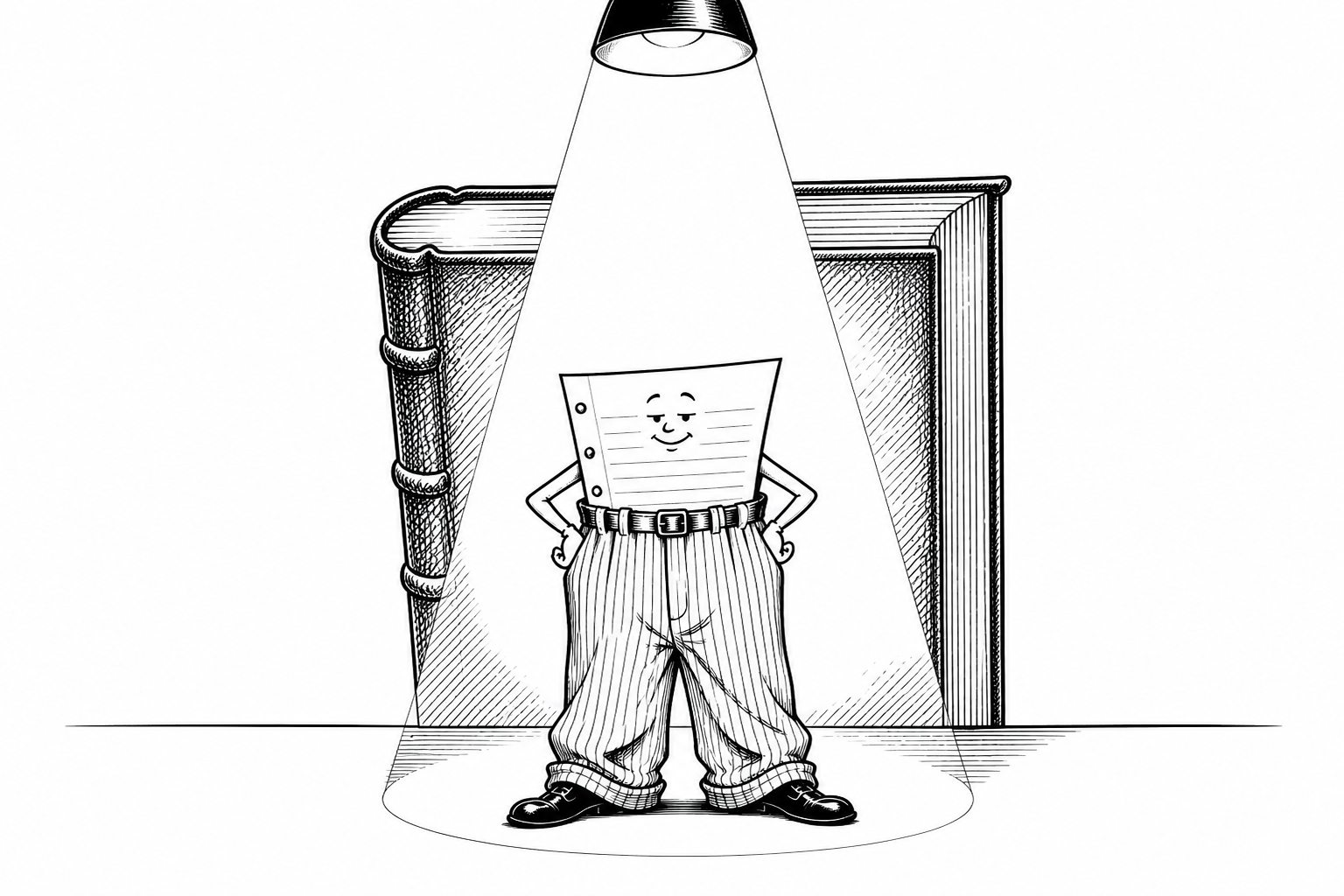
If all you have is one attractive moment surrounded by silence, you may have a very good scene wearing ambitious trousers.
Write it anyway.
The decision happens before the first chapter
Some writers begin drafting to discover whether an idea works. That has never been his method.
In more than thirty years, he has never abandoned a manuscript because the original idea ran out of road. He decides that the story has life before committing to it—not through formal analysis, but because he can already feel its movement.
That does not mean he knows what will happen. He very rarely does.
It means he can sense characters worth following and situations capable of changing. Once those characters begin reacting to one another, the story generates its own momentum.
Characters do not merely decorate the plot. They cause it.
Their decisions create events. Their reactions alter relationships. Their conversations reveal the next direction, frequently without consulting the person supposedly in charge of writing them.
The author’s job becomes one of guidance.
Rather like an electric toothbrush, apparently: hold it, point it in roughly the right direction and resist the urge to interfere with the mechanism doing the actual work.
Literature has suffered worse comparisons.
What if you only know one scene?
Write the scene.
Do not delay it because you cannot yet explain what happens immediately before it, what happens afterwards or why somebody is carrying a bloodstained garden ornament through a railway station.
The surrounding story may reveal itself once the scene exists.
This is where writing out of order becomes useful. A scene can remain inside the manuscript while the missing sections are built around it. It becomes one of the fixed points the characters must eventually reach.
The previous article compared this process to constructing a bridge in separate sections. You may know how one section looks long before you possess the materials for the section preceding it. Build the part you can see. The joins can be solved later.
Agonising about the missing pieces does not make them appear. It merely prevents the available piece from being written.
Ideas change when exposed to reality
Thinking about a story is useful. Talking about it is useful. Neither damages the idea unless you spend so long discussing it that everybody involved dies of natural causes.
But an imagined story and a written story are not the same object.
It is much like photography. You can picture the perfect image before taking it, only to discover that the light, angle and inconvenient physical universe have produced something entirely different.
Writing does the same thing.
Once the characters begin speaking, the story may travel somewhere unexpected. For a discovery writer, that is not evidence that the original plan failed. It is the reason for writing in the first place.
The author discovers the story alongside the reader—admittedly with earlier access to the manuscript and considerably more responsibility for the commas.
Genre matters, but it does not make the decision
Genre and readership cannot be ignored. Readers develop expectations, particularly when an author has become known for a recognisable type of book.
Write legal thrillers for long enough and people become mildly unsettled when presented with a quiet family memoir. Write supernatural thrillers and somebody will eventually complain that the latest book contains an insufficient number of disturbed spirits.
But audience expectations have never decided whether this author writes a particular story.
The idea decides.
His books cross genres because writing the same kind of story repeatedly would eventually become boring. Most remain connected by suspense, atmosphere and psychologically driven characters, but commercial familiarity is not allowed to become a creative prison.
Sometimes a writer must step away from a familiar genre to return to it with something worth saying.
And sometimes a book must be written despite the likelihood that it will never become the most commercially successful work in the catalogue.
Most long careers contain at least one such book: personal, cathartic and necessary. Its value lies partly in having been written at all.
Not every book has to justify its existence to a sales dashboard.
Never throw away a useful corpse
Although he has never abandoned a complete manuscript, scenes have certainly been removed.
A scene may be good and still fail to serve the particular book surrounding it. It may interrupt the pace, duplicate something expressed elsewhere or simply belong to another story that has not arrived yet.
Keep it.
Deleted scenes, unused characters and rejected ideas should be stored rather than destroyed. They are not necessarily failures; they may simply have turned up for the wrong manuscript.
The important thing is not to force them into another book merely because they already exist. Keep them until they fit somewhere naturally. A scene written years earlier can become exactly what a later manuscript requires.
Nothing useful needs to be wasted.
It merely goes into storage and waits to frighten another set of characters.
The only useful test
There is no universal method for proving that an idea can sustain a novel.
Ask whether it interests you.
Ask whether it continues producing scenes, characters, tensions and possibilities.
Ask whether spending the next year with it sounds compelling—or like a custodial sentence.
Then begin.
If you have an entire premise, begin with that. If you know the ending, write towards it. If you possess nothing except one scene that refuses to leave you alone, write the bloody scene.
Everything surrounding it can be built once something exists.
What happens next? If you have the scenes but no grand plan holding them together, read Do You Need to Outline a Novel?. It explains how a story can be assembled like a bridge—one available section at a time.


Leave a Reply