
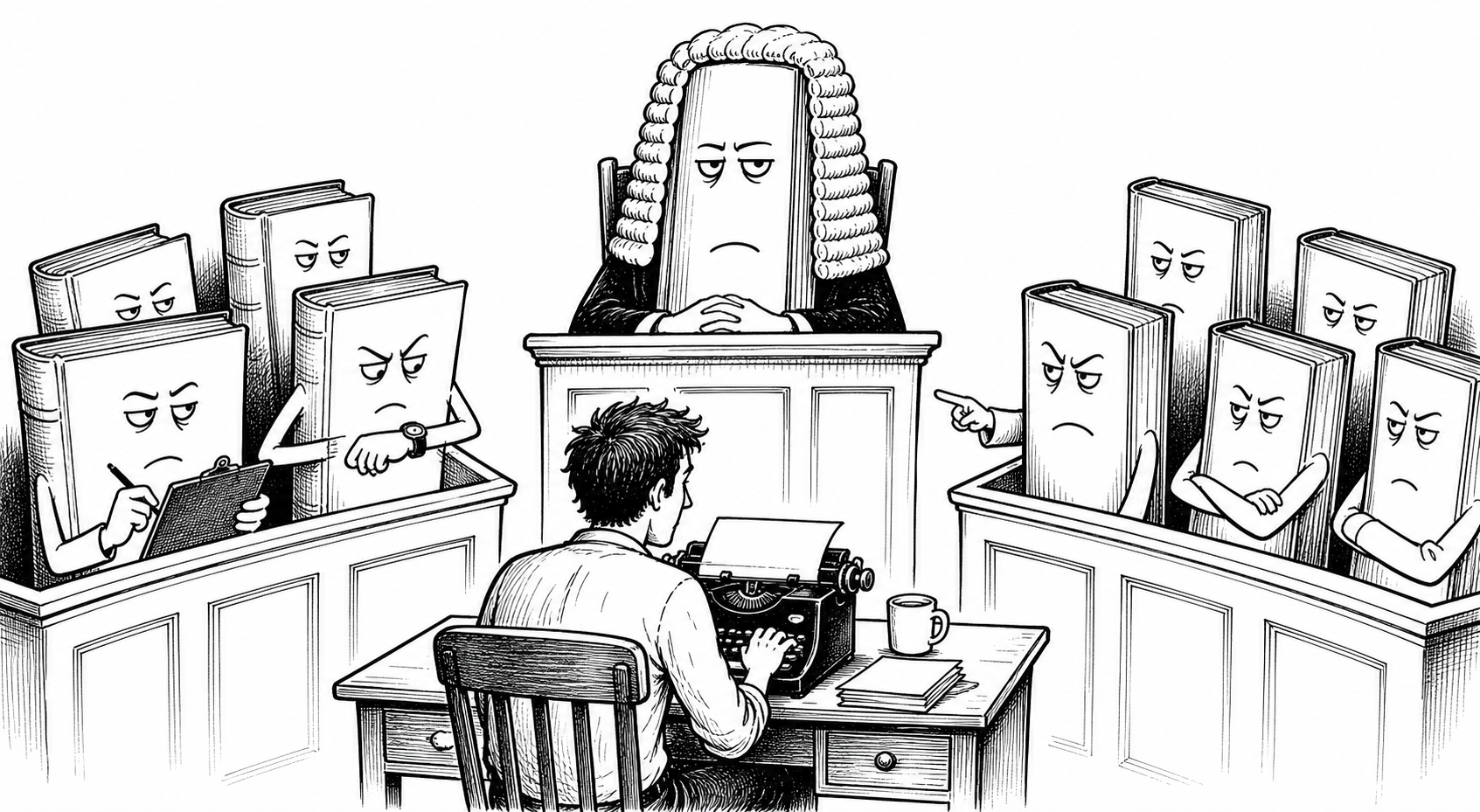
Writers are frequently told that they must read constantly. Not occasionally. Not when the mood takes them. Constantly—as though a novelist’s professional licence may be confiscated after three consecutive evenings without a paperback.
Reading is said to teach rhythm, structure, character, dialogue, pacing, genre and the useful habit of noticing when somebody else has already had your brilliant idea. All of that can be true. The difficulty begins when useful advice puts on a judge’s wig and starts handing down sentences.
The author-publisher whose experience informs these articles has written novels for more than thirty years, across several genres, and sustained a paying readership throughout enormous changes in the trade. He rarely reads novels.
This is not a manifesto against books. It is not a contrarian productivity system. His body simply regards sitting still with a book as an unusually elaborate way of preparing for sleep. He keeps largely nocturnal working hours, and when reading time finally appears, consciousness often leaves first.
Audiobooks work rather better because they can accompany driving, walking and the hundreds of jobs that require enough attention to keep moving but not enough to prevent a second voice entering the room.
Useful is not the same thing as compulsory.
What writers can learn from other writers
Reading widely can be a remarkable education. It reveals how other writers control time, plant information, conceal machinery and persuade a reader to turn one more page at an hour when everybody involved should plainly be asleep.
It can also show what a genre promises its readers. Crime fiction, romance, horror and historical fiction each develop expectations—not rigid laws, but agreements made quietly between a book and the people buying it. Knowing those agreements is useful.
But imitation can arrive without knocking. A writer reads one voice intensely, then discovers somebody else’s furniture quietly appearing in the living room: a borrowed cadence here, a suspiciously familiar detective there, an entire narrative sofa nobody remembers ordering.
None of this makes reading dangerous. It merely makes it one route into craft rather than the route.
If not books, where does the education come from?
From writing, mostly. From finishing manuscripts, revising them, breaking scenes open, discovering what collapses under pressure and learning that a sentence can be technically correct while remaining completely dead.
It also comes from readers. For decades, this author-publisher has used focus groups and direct reader feedback to learn where a story holds attention, where a character ceases to feel truthful and where an apparently subtle plot point has been so subtle that it has effectively left the building.
Thirty years ago, a focus group did not mean emailing a PDF and watching comments appear in a shared document. It meant photocopied or printed pages, physical manuscript parcels, postage, waiting and handwritten observations returning weeks later—sometimes with the delicate tact of a minor collision. Feedback carried friction, weight and occasionally insufficient stamps.
That process taught craft through consequences. If several real readers stumble in the same place, the problem is rarely that all of them have simultaneously become poor readers.
Learning about people by looking at people
His fiction is driven chiefly by psychology and human behaviour. That education came from paying attention to people: what they say, what they avoid saying, how affection and resentment can occupy the same conversation, and how the version of ourselves presented in public is often working from a heavily revised manuscript.
Film and television contribute too. Good screenwriting demonstrates compression, subtext and momentum. Bad screenwriting can be equally educational because the joins are visible. A character explains something no human being would explain, behaves solely because the plot requires transport, or undergoes a complete personality renovation between commercial breaks.
Watching something fail can teach structure with unusual efficiency. The lesson arrives already highlighted.
Literary Catholicism
Some writing advice is delivered less as guidance than as Literary Catholicism. You must read the canon. You must know the rules. You must confess beneath a tower of unread paperbacks and promise to do better before attempting chapter two.
This can make new writers feel fraudulent before they have written anything. They begin assembling proof that they are allowed to write: courses, shelves, systems, annotated classics and a vocabulary impressive enough to explain why the manuscript remains at four hundred words.
The question is not whether you completed the approved reading list. It is whether the story works.
Reading may help enormously. So may theatre, conversation, documentary, lived experience, professional knowledge, obsession, memory, travel, music and the peculiar neighbour who moves furniture at three in the morning. A writer’s education can be assembled from more than one kind of evidence.
Can a light reader become a good novelist?
Yes. Just as a constant reader can become a poor novelist. Consumption and creation are related, but they are not the same activity.
The more useful questions are whether you understand people, whether your story develops rather than merely continues, whether your characters behave like themselves, whether you can recognise weak work in revision and whether you are willing to listen when readers consistently find the same fault.
If reading strengthens those abilities, read. If audiobooks fit your life better, listen. If your education arrives through psychology, observation and doing the work repeatedly, use it. The method does not need to look literary enough for a photograph.
A writer who reads constantly but never finishes a manuscript is still not finishing a manuscript. A writer who reads lightly, writes seriously, revises honestly a Very Good Scene Wearing Ambitious Trousers?




Leave a Reply