
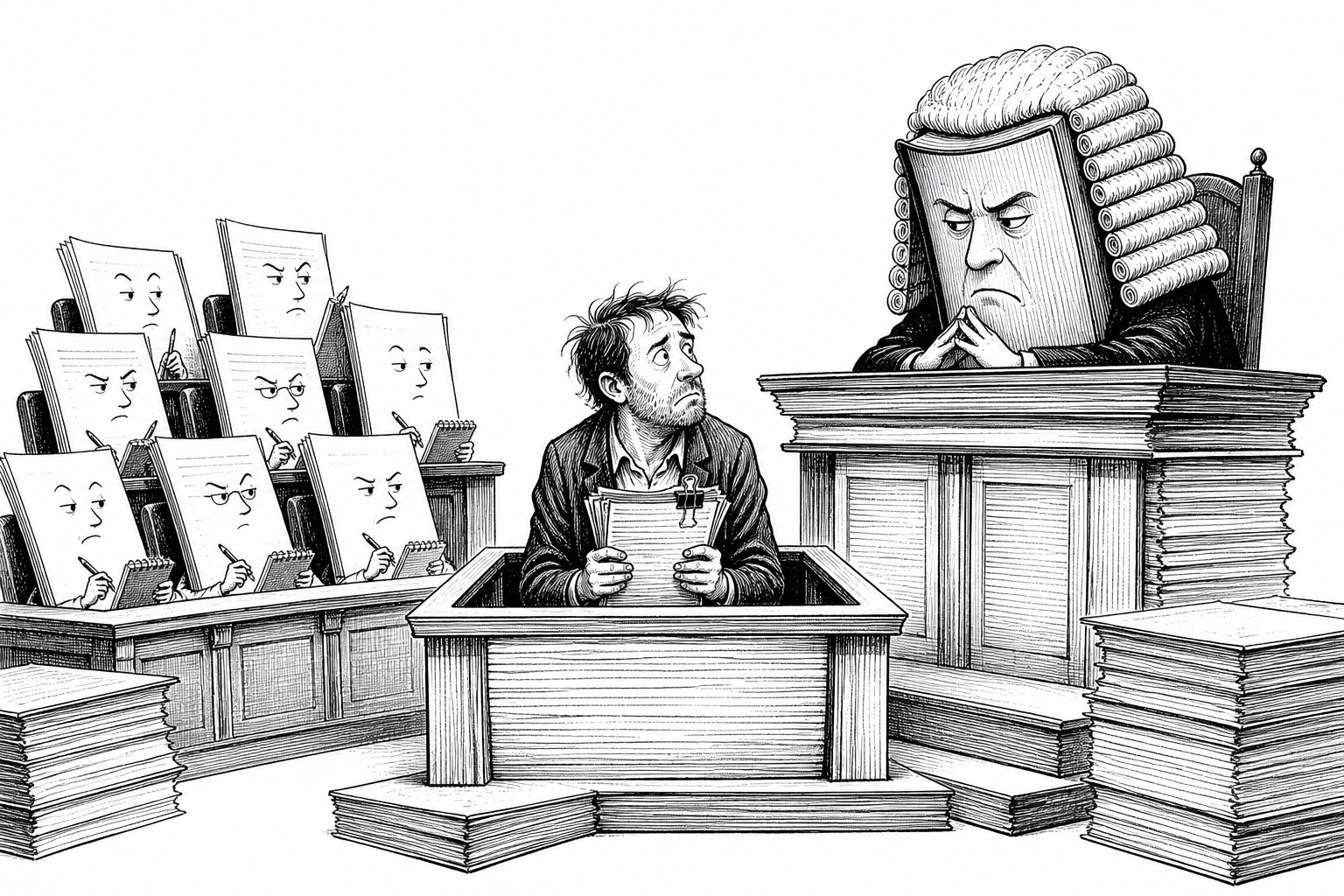
A novel rarely has the courtesy to announce that it is not working. There is no warning light on the dashboard, no helpful bell and certainly no small official from the Ministry of Fiction arriving with a clipboard.
Usually, there is only the writer, staring at a scene that has stopped producing another scene and wondering whether the entire book is dead or whether Tuesday has simply happened again.
After thirty years of writing and publishing books, the author-publisher whose working methods inform this series has learned to treat that first burst of panic with suspicion. Writers are not always reliable witnesses to their own manuscripts—particularly while trapped inside them.
The first sign that a story is alive
For a discovery writer, a story is working when one scene begins to breed another. A conversation suggests a confrontation. A character makes an apparently innocent remark and quietly creates three chapters of trouble. One scene may even produce something much later in the book: a jigsaw piece that cannot be fitted yet, but clearly belongs somewhere.
That multiplication is momentum. It does not mean the writer knows the route. Quite the opposite. The pleasure lies in discovering that the route exists at all.
When scenes stop generating possibilities, attention is required—but not necessarily demolition.
A stalled scene is not necessarily a failed novel.
Sometimes the problem is only today
How much alarm is justified depends partly on how far the book has travelled. If a writer is a quarter of the way through and reaches a scene that refuses to open the next door, that is not a post-mortem. It is an occupational hazard.
Leave it alone. Go away. Return tomorrow.
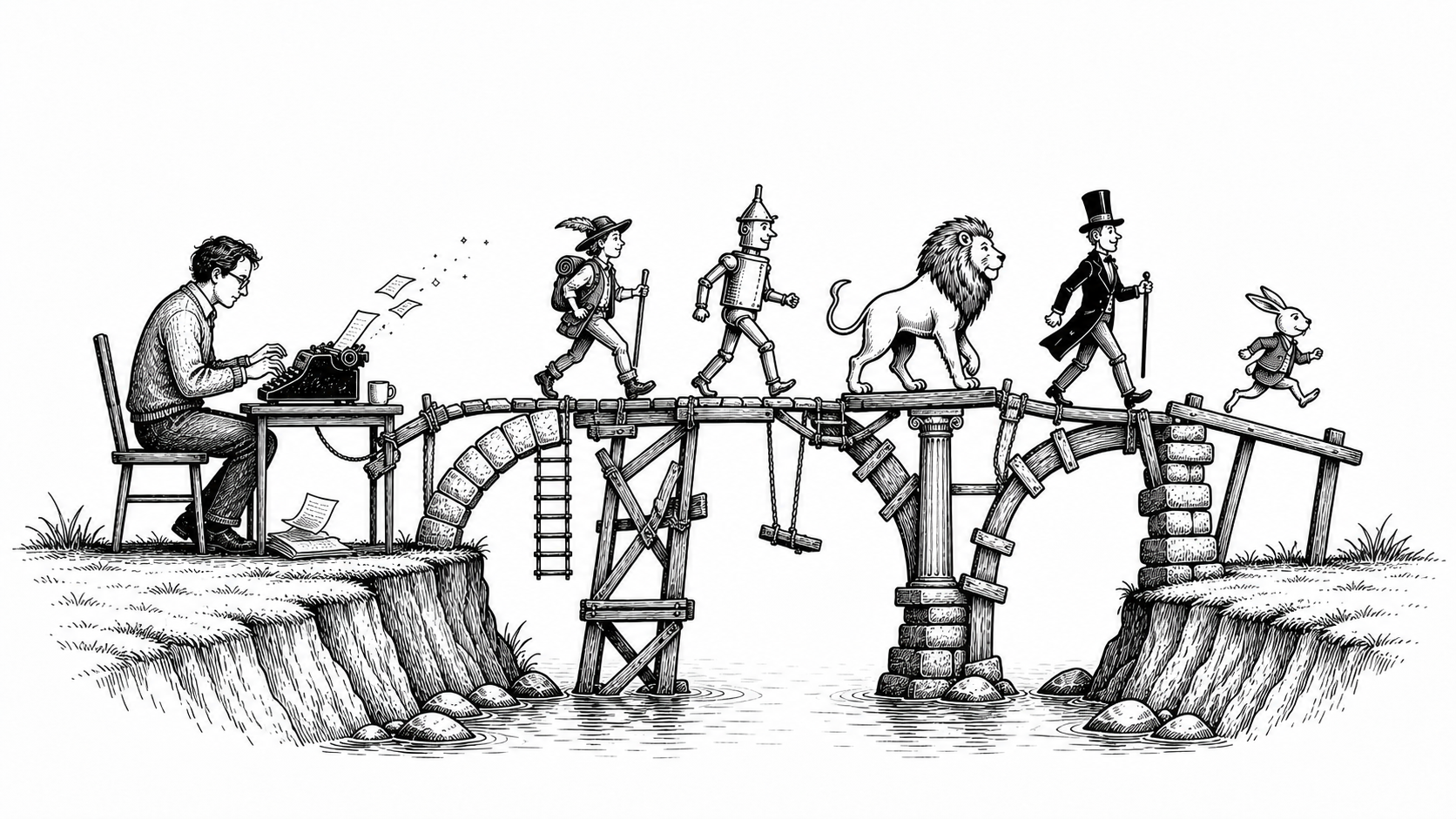
Distance changes the shape of a problem. Characters that appeared mute at midnight may become surprisingly talkative after breakfast. A bridge between two sections may appear once the writer stops trying to manufacture it by force. Very few manuscripts are improved by somebody glaring at them continuously until both parties become unreasonable.
The useful question is not merely, “Am I stuck?” It is, “What happens when I stop pushing?” If the book begins offering possibilities again, it was not dead. It was resting without having completed the appropriate paperwork.
When one book turns out to be two
Sometimes a manuscript is working, but not in the shape the writer assumed.
One long novel in this author-publisher’s backlist divided naturally between England and Italy. The Italian section became darker and more gothic; the length kept growing; the two halves began to feel as though they had met at a railway station and mistakenly exchanged luggage.
The manuscript went to a focus group. The response was unanimous: these were two books.
That verdict did not require abandoning the story. It required recognising its actual architecture. The manuscript was split, and each half received the beginning and ending it needed. What looked like structural failure was really a book refusing to remain in the container chosen for it.
Repeated feedback is not background noise
One reader can dislike something for reasons that belong entirely to that reader. A second may agree by coincidence. But when several suitable readers independently stumble in the same place, the writer should stop explaining why they are all wrong and inspect the floorboard.
If several target readers independently flag the same thing, it is no longer noise. It is a signal.
The same applies to praise. If a group responds strongly to the same character, scene or turn in the story, that matters too. A focus group is not assembled so the writer can collect applause, reject criticism and return home with the manuscript’s ego freshly polished.
Useful feedback does not mean obeying every suggestion. Readers are often better at identifying where something stopped working than prescribing the repair. The writer still has to decide what change belongs to the book.
Useful doubt and the common impostor
Early in a writing life, doubt can be relentless because there is not yet enough external evidence to argue with it. Rereading the same manuscript exhausts perspective. A passage can look brilliant on Monday, criminal on Wednesday and merely over-punctuated by Friday.
Experience does not abolish that uncertainty. It makes it easier to recognise. After three decades, this author-publisher still would not claim to know everything about writing. He shares what experience has taught him and remains deeply suspicious of anyone who has converted a personal preference into the one correct system for everybody else.
Writers are individual. Give ten cooks the same recipe and at least one will improve it, one will ruin it and another will insist the oven was emotionally unavailable.
The practical response to self-doubt is often less dramatic than the feeling itself: finish the draft, obtain honest reactions and assess the evidence. A writer’s frightened internal commentary is not a substitute for readers.
Sometimes the writer changes
A book can also stall because the person returning to it is no longer the person who began it.
One planned project originally leaned into graphic demonology and deliberately extreme material. It was left for a later instalment in a series. Two or three years passed. When the author returned, his understanding of the readership—and of what he actually wanted the story to do—had changed.
The book was not rescued by forcing the original intention back into service. It found a different direction: less gratuitous, more purposeful and better suited to the series it had become part of.
Changing direction is not automatically a failure of nerve. Sometimes it is evidence that the writer has finally caught up with the book.
The eighteenth draft may be trying to tell you something
Revision is essential. Endless revision is not necessarily heroic.
The author-publisher has watched a manuscript pass through eighteen drafts after a writer changed genre, received poor focus-group responses, revised repeatedly and eventually published largely to get the thing off the desk. By that stage, the process had stopped being refinement and become a long administrative siege.
His own books rarely travel beyond four or five substantial drafts. That is not a universal limit, but eight or ten rounds of major rebuilding should prompt a different question: does the manuscript need more effort from the same exhausted person, or an experienced outside assessment?
A developmental editor or genuinely candid reader may see in an afternoon what the writer has been sanding for six months. Constant polishing can remove the book’s personality while leaving its underlying problem untouched.
When should you abandon it?
A difficult book is not necessarily a dead book. Difficulty can mean the writer has created an interesting problem and has not yet found the solution.
Abandonment becomes reasonable when interest in the story has gone and no alternative version of it creates even a flicker of curiosity. Not when a chapter is awkward. Not when confidence disappears for a week. Not when one reader dislikes the protagonist’s shoes.
Before making a drastic decision, obtain outside evidence—and choose the outside carefully. Do not ask a crony whose principal qualification is a willingness to stroke your ego. That is not feedback. It is a slower and more expensive way of agreeing with yourself.
Before you dismantle the book, ask yourself a more uncomfortable question: are you a reliable witness?
Most writers, at the exact moment they are considering burning a manuscript, are not.
Finish enough of the book to produce evidence. Step away when necessary. Listen when several suitable readers tell you the same thing. Change its shape if the story demands it. Seek experienced help when revision has become circular.
And remember the irritatingly simple question beneath all of this: how do you know whether it is any good if you have not written it yet?







Leave a Reply