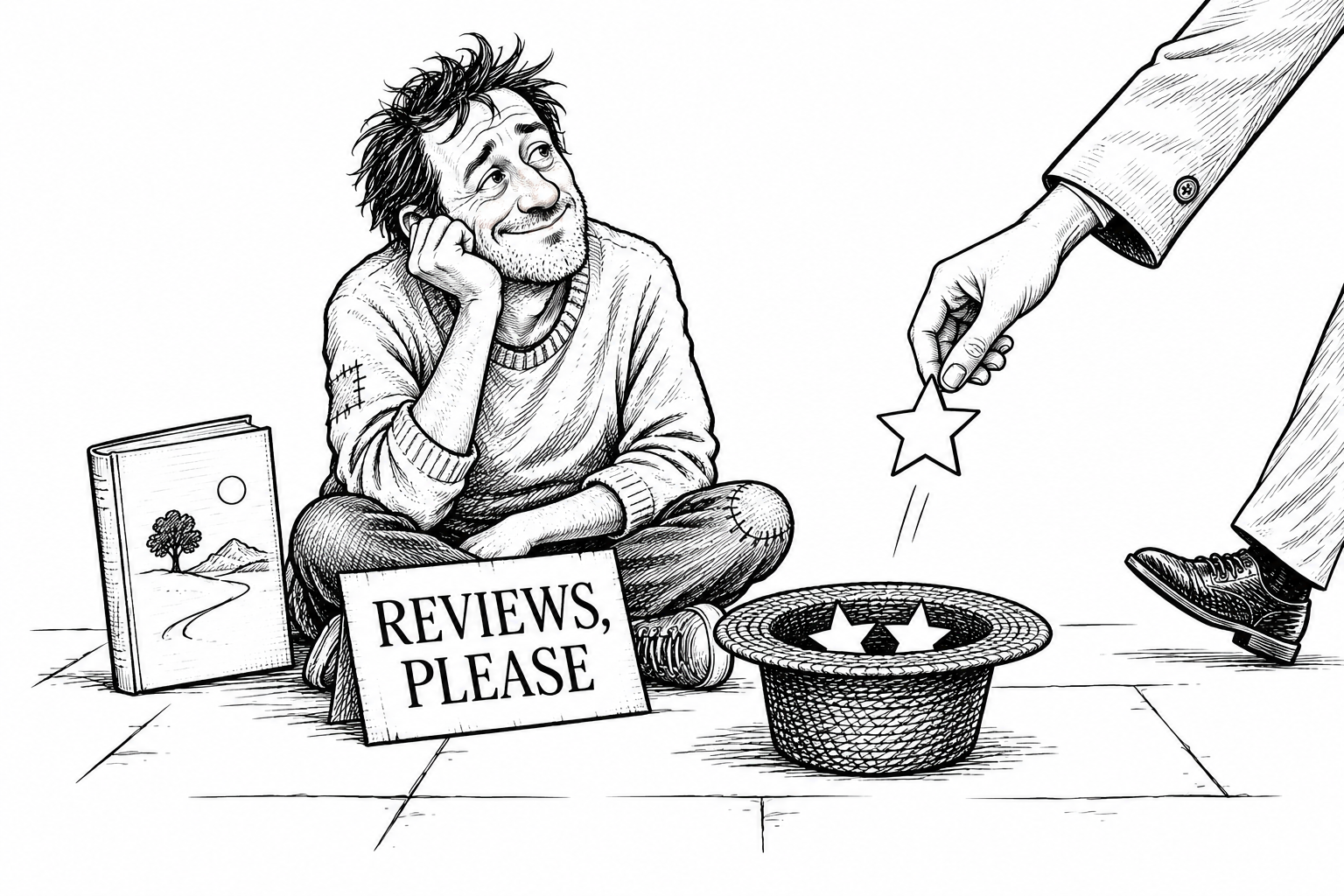
You have published a book. There it sits, wearing its expensive cover, with no reviews beneath it. A restaurant with no customers. A party at which the host has started rearranging the crisps.
You know how much work went into it. The prospective reader knows that you would like some money.
This is why reviews matter. Someone deciding whether to surrender their latte money and several evenings would quite like evidence that the last person survived the experience. Your assurance that the novel is gripping carries approximately the same independent authority as a restaurant describing its own soup as delicious.
But getting useful reviews involves more than persuading enough people to press stars. It begins with finding people who might actually want the book.
The public is a rather late editing department
Tony Marturano distinguishes between the feedback that helps you finish a book and the reviews that help someone else decide whether to buy it.
The first should already have happened: readers, editing, revision, proofing, the uncomfortable discovery that a scene you adored has exhausted everybody else. Public reviews can still teach you things, but launch day is an expensive moment to discover that the manuscript needed professional attention.
By then, reviews are doing a commercial job. They offer evidence from outside the author’s own increasingly persuasive head.
The temptation is to get that evidence from absolutely anybody. More readers, more ratings, more reassurance. What could possibly go wrong?
Tony once received a one-star review from someone who, in his account, thought the book looked too dense and therefore did not read it.
An admirably efficient reviewing method. One could clear a substantial reading list before breakfast.
The written explanation exposed the absurdity. The star remained a star.
You cannot prevent every encounter of this sort. You can, however, avoid treating the entire human population as equally promising first readers. Somebody who dislikes slow psychological suspense may object to a book for delivering precisely what its intended audience came for.
Tony’s preference is to start with relevant readers and broaden from there. This improves the odds; it does not create a small, obedient nation in which everybody loves your ending. Genres overlap, tastes vary, and readers retain the inconvenient freedom to surprise you.
Ask for honesty without turning it into homework
There is nothing inherently undignified about asking a reader for an honest rating or review. The indignity tends to arrive with the fourth reminder and the suggestion that your future depends on their immediate cooperation.
Tony puts an appeal at the back of his books. He has increasingly emphasised a rating because the word “review” can sound like an assignment. Someone who would happily choose a star rating may defer composing a considered paragraph until a quieter moment, currently pencilled in for retirement.
A short, neutral invitation does the job: if you have read the book, an honest rating or review helps other readers decide whether it is for them.
No desired star count. No reward. No request to contact the author privately if disappointed while directing happy readers towards the public page.
Keep the emotional invoice out of it. Buying the book has not enrolled anyone as an unpaid member of your publicity department.
Even clear requests produce less response than an author might hope. Tony’s own experience includes occasions when roughly a quarter or fewer of buyers left ratings, with written reviews rarer still. That is his observation, rather than a benchmark your launch must meet. The useful expectation is simpler: silence is common, and repeated pestering does not make it more affectionate.
Free copy, independent opinion
Advance reader copies can help a book reach people before launch. Tony regards them as one of the more credible routes to early reviews, provided readers remain free to dislike the book or say nothing at all.
He has seen ARC readers give less than five stars. This is reassuring. A system in which every reader emerges delighted is either a literary miracle or worth a closer look.
There is a practical policy boundary here. Amazon permits free or discounted book copies, but you cannot require a review in exchange or try to influence it. Adding other incentives, including gift cards, invalidates the review. Goodreads likewise prohibits required, influenced and paid reviews.
An ARC invitation can explain the publication date and welcome an honest response. It cannot turn the free copy into a debt payable in stars.
Transparency matters too. Goodreads asks advance readers to identify where their copies came from. In the United States, FTC guidance on endorsements explains when a free product or another material connection needs disclosure. A plain statement that the author or publisher supplied the copy is more useful than hoping everyone decodes an abbreviation.
Tony’s instinct for a new author is to begin with actual readers within reach. Sensible, with one qualification: use people you know to find relevant readers and obtain private feedback, rather than assuming close friends and relatives are suitable Amazon reviewers. Amazon excludes reviews involving perceived close personal relationships. Your mother’s faith in you may be considerable. It is not an independent research finding.
From there, build contact with readers who have an interest in the kind of book you have written. Check what any ARC service actually provides: access to readers, file delivery, administration, or something else. Those are different services. None should be confused with purchasing a favourable customer verdict.
A thousand downloads can be a very quiet room
Tony has run free campaigns that shifted thousands of ebook copies without producing a corresponding movement in readership.
The dashboard looked busy. The books may have been less so.
His suspicion is that some free-book subscribers are collectors. Acquiring the book supplies a small pleasure; reading it is a separate appointment. Digital shelves, mercifully, do not collapse and force the issue.
This does not make every free copy a mistake. An advance reader interested in a forthcoming release has a different reason for accepting it from somebody collecting anything temporarily reduced to nothing. A free entry point to a paid series also has a commercial purpose, if readers actually continue.
The distinction is intent, followed by results.
Tony generally prefers a discount that preserves some sense of value. That reflects his experience and commercial judgement, not a law under which free books become unreadable. The question is whether the offer gets the book read by suitable people.
A download is evidence of acquisition. It is not evidence of completion, enthusiasm, a review, or a future purchase. Calling all five the same thing does make a report easier to write. Unfortunately, it makes the report less useful.
A download is evidence of acquisition. It is not evidence of completion, enthusiasm, a review, or a future purchase.
Twenty blog stops, nobody getting off
The same scrutiny belongs on paid publicity.
Tony is sceptical of book-tour packages selling a long itinerary of small blogs with little evidence of a relevant audience. Twenty appearances can sound impressive until you ask who was there.
That is a question about the particular sites, rather than a dismissal of book bloggers. A small, trusted readership can be valuable. A large list of unattended pages is still unattended.
Look at presentation, recent activity, the readers being reached and what the fee buys. Are people discussing books like yours? Is there reason to expect discovery or sales? Will the coverage be seen? A professionally produced cover does not automatically benefit from being displayed somewhere that looks as though the webmaster left during the previous government.
Be equally clear about the distinction between buying publicity or a separately labelled editorial service and buying customer praise. Calling something a “professional review” does not answer where it will appear or whose independence is being sold.
Follower counts deserve the same raised eyebrow.
Tony reports that his TikTok activity and advertising have done very little for his book sales, while Facebook has produced materially better results for him. That is a comparison from his campaigns. It cannot tell another author that their readership is in the same place.
It does explain why he wants more than a screenshot of a large following. People can follow a creator for their humour, style, opinions or beautifully arranged shelves without buying the next book mentioned.
The useful question is whether this audience responds to books like yours. An influencer has their own business and incentives. Discovering your novel is not necessarily the vacancy they are trying to fill.
When the bad reviews have a point
There is a danger in learning that some reviews are unfair: you begin applying the discovery to all of them.
One reader may miss an explanation. They were interrupted, distracted or simply read the scene differently. You do not need to rebuild a novel every time somebody loses the thread.
Several unrelated readers describing the same problem deserve attention.
Early in his career, Tony trusted a vanity publisher that promised professional editing and proofreading. The published book contained substantial problems. Reviews began discussing its need for editing rather than the story.
A later edition addressed the work, but in Tony’s experience its reputation never fully recovered. The first conversation had already formed around the defects.
That is a rather more useful lesson than “ignore the haters”. Fixing a book also does not wipe its review history: Amazon says it does not remove older reviews merely because an updated edition has made aspects of them irrelevant.
Check the audience fit. Look for repeated, specific criticism. Correct what can responsibly be corrected and carry the lesson into the next book. There is room between surrendering to every complaint and appointing yourself the only person who has understood the masterpiece.
Getting reviews is therefore fairly ordinary work: prepare the book properly, find plausible readers, make an honest invitation easy to act on, and judge promotional routes by what they deliver.
There may still be someone who awards one star without reading it.
Try not to let them become the most influential person in your publishing business.
For the wider publishing journey after the manuscript is finished, start with So You Finished the Book. Now What?.