
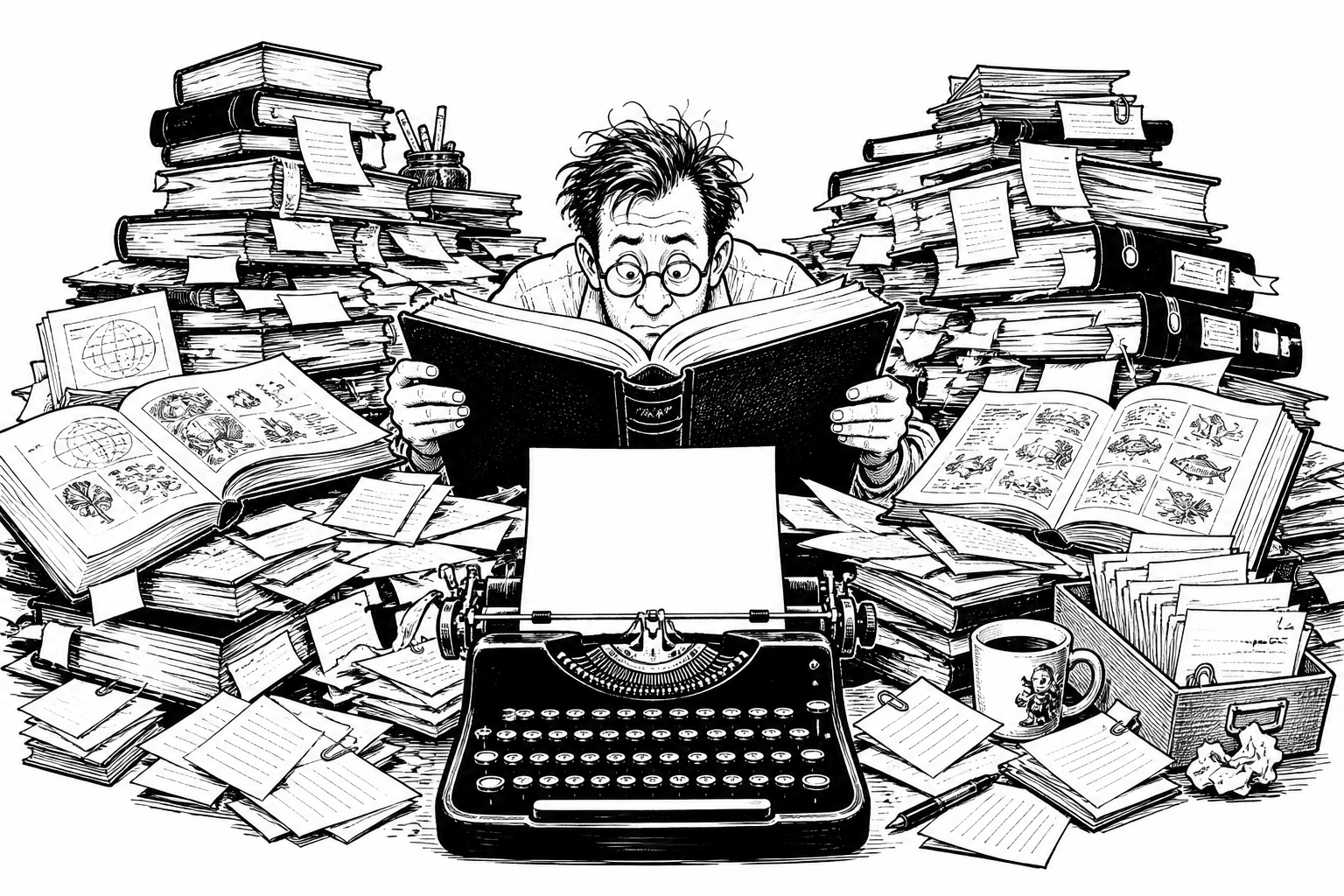
Research has an excellent reputation. It looks serious. It produces notebooks, browser tabs and the occasional stack of books capable of injuring a small dog. Most importantly, it can feel remarkably like writing while requiring no actual sentences from the writer.
The difficulty is knowing when research becomes procrastination—and starts wearing seriousness as camouflage.
That does not make research unnecessary. It makes it unusually good camouflage.
The author-publisher whose working methods inform this article has been writing and publishing books for more than thirty years. His approach is not to know everything before beginning. It is to know enough to begin—and to discover the rest when the story reveals what it actually needs.
Do enough research to begin. Then begin.
Research used to be a separate expedition
Before the internet, research was difficult to do dynamically. A writer could not pause midway through a paragraph, confirm a technical detail in twenty seconds and return before the sentence had cooled down.
Information had to be found in libraries, books and physical reference material, then collated before the writing properly began. If a novel depended on an unfamiliar profession, historical period or specialist process, much of that groundwork had to be completed in advance.
This made research slower, but it also gave it a natural stopping point. Eventually the books went back, the notes sat on the desk and the manuscript had to earn its keep.
Modern research has removed the inconvenience and, with it, some of the restraint. A writer can now investigate indefinitely. There is always another source, another interview, another reassuring hour in which nothing dangerous—such as a first draft—has to occur.
How much should you know before starting?
Enough to know that the story has legs.
That means examining the idea itself rather than attempting to complete an unofficial doctorate in every subject the novel might brush against. Is there more than one scene here? Where might the pressure come from? Which situations already have energy? Can the central idea change, deepen or cause trouble?
If those questions produce movement, the story is ready to be written. The technical detail can arrive when it is needed.
This matters because many research questions do not exist until the characters begin behaving. A writer may know that a character is an astrophysicist, solicitor or surgeon, but not yet know which part of that profession the story will actually demand. Researching the entire field in advance is an impressive way to learn a great deal that never reaches the page.
Research the profession; let the person live
One character in a recent project worked in a field unfamiliar to the author. The technical framework required research: what the job involved, what language belonged to it and which actions would feel natural or absurd.
But the character himself did not emerge from a reference book. Once the practical boundaries were understood, he began to think and speak as a person rather than a research assignment.
That distinction is useful. Research should give a character solid ground to stand on. It should not operate the character by remote control.
The first draft does not need every answer
A missing fact is not always a reason to stop. Often it is simply a note for later.
If a scene depends on a detail you do not yet know, mark the gap and continue. Write the emotional movement, the conflict, the discovery or the disaster. Return during revision and establish whether the door really locks that way, whether the procedure takes six minutes or sixty, and whether the apparently excellent plot twist has just violated three laws of physics and a minor local by-law.
A missing fact is a note for later—not permission to abandon the book.
This is another advantage of writing in pieces. If one section needs information you do not yet possess, write the section that does not. The whole manuscript need not stand outside the library waiting for one troublesome fact to finish its lunch.
Accuracy matters because readers can feel the floor move
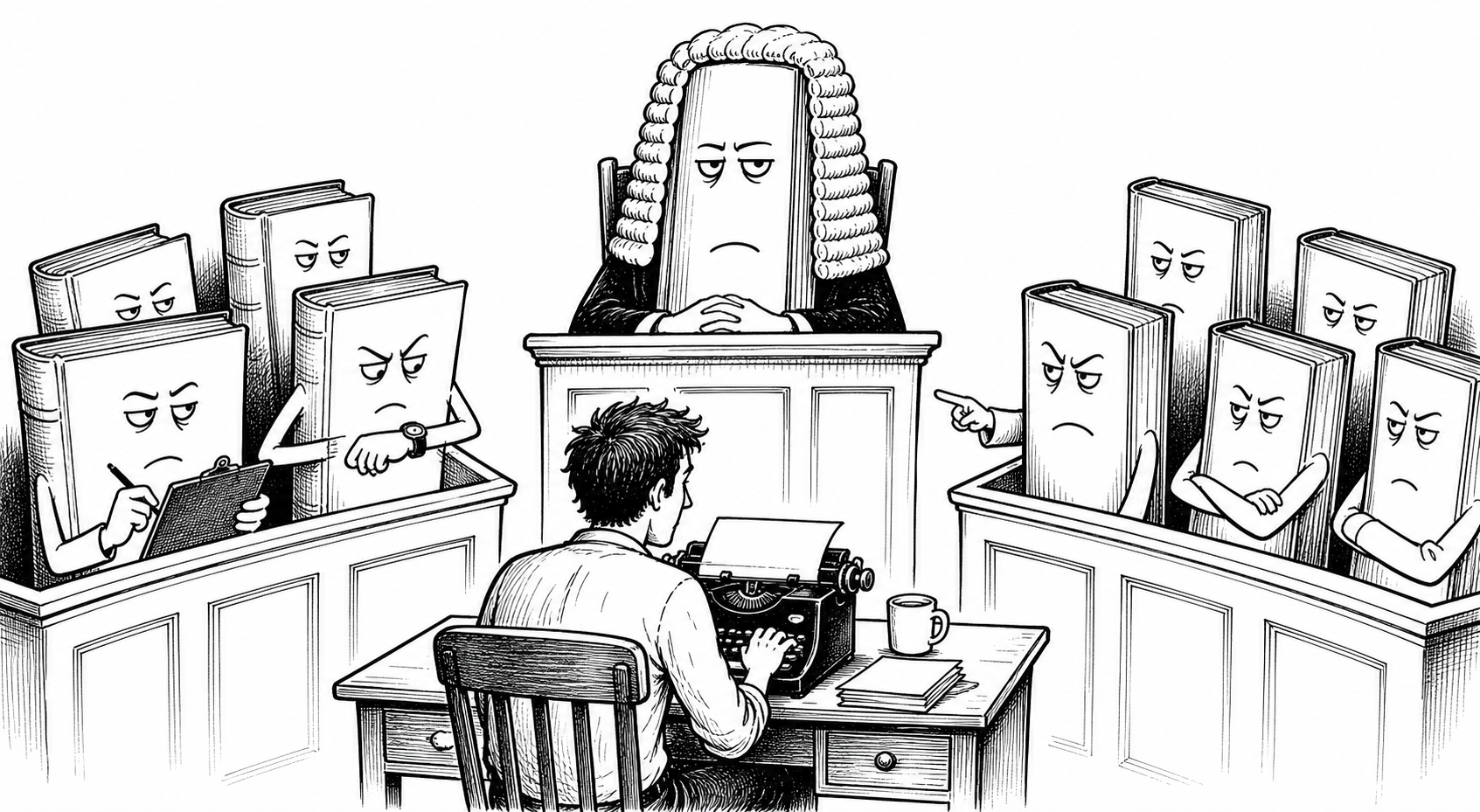
Fiction can ask a reader to accept almost anything, including ghosts, impossible coincidences and people who answer unknown telephone numbers. What it cannot do comfortably is make the surrounding world feel careless.
The more extraordinary the premise, the more useful ordinary reality becomes. Believable behaviour, recognisable emotion and accurate practical detail give the reader something firm to stand on while the impossible enters the room.
Reality is terrifying enough.
For this author-publisher, realism is not an obstacle to frightening fiction; it is what makes the frightening parts work. Readers are disturbed by what they can recognise. The supernatural may open the door, but human behaviour is usually what persuades them to remain in the house.
When does research become procrastination?
It becomes procrastination when it is no longer answering a question the manuscript has asked.
If you are researching because the next scene genuinely requires a fact, carry on. If you are researching because beginning the scene might expose whether it works, the problem is no longer a lack of information.
A useful test is brutally simple: can you write something today with what you already know? If the answer is yes, write it. If the answer is no, identify the exact missing fact, find it and return. Do not broaden the inquiry until you have accidentally become the leading regional authority on nineteenth-century drainage.
You cannot know everything before the story exists
The demand to know absolutely everything before beginning sounds careful, but it asks for the impossible. The story will change as it is written. Characters will make choices you did not anticipate. A minor scene will become important. A magnificent piece of research will discover that it has no speaking part.
You can only learn what this particular novel needs by allowing the novel to exist.
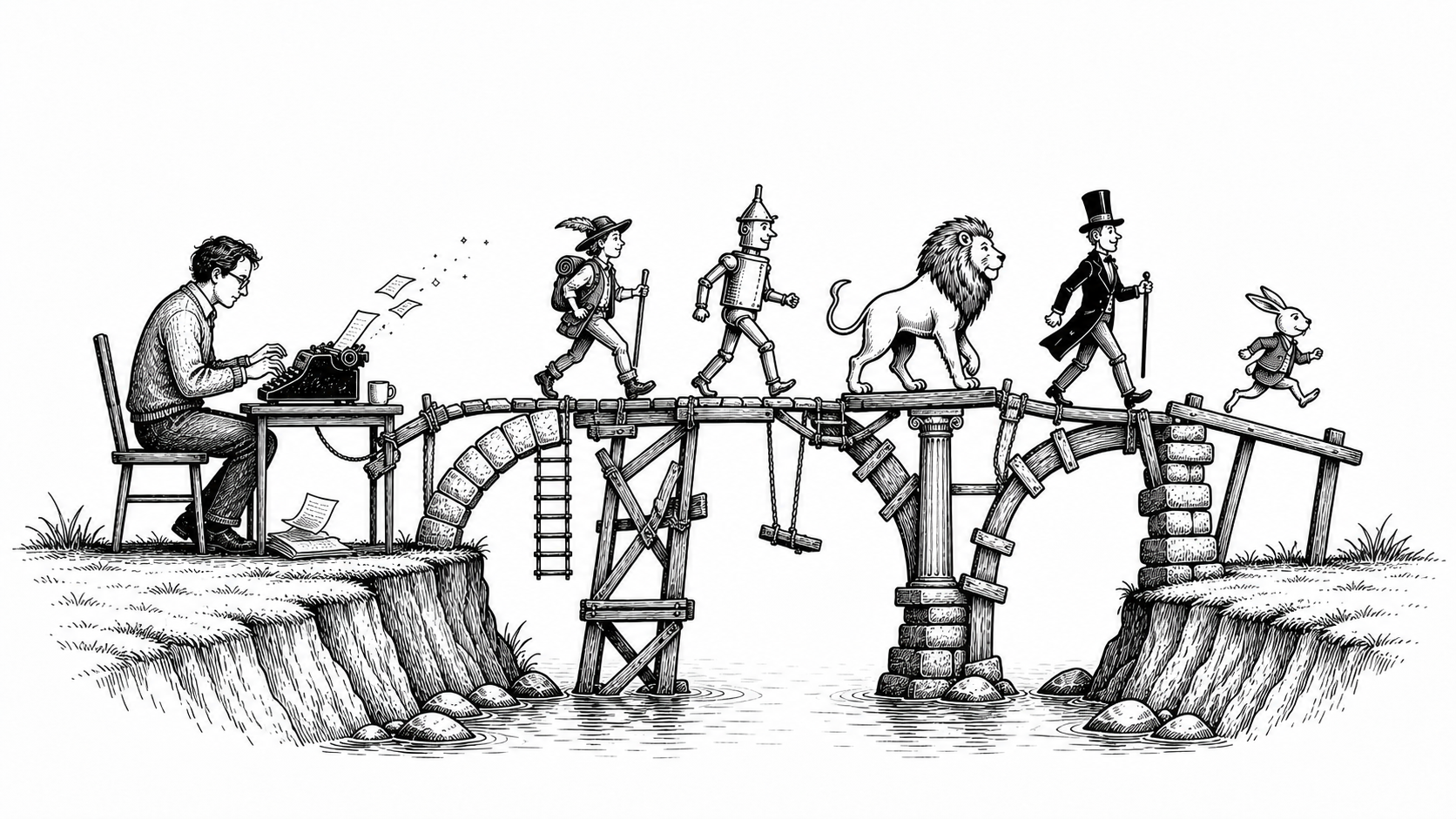
Research enough to make the first steps credible. Write until the story exposes a gap. Fill that gap. Then keep going.
The research serves the book. The moment the book exists mainly to justify the research, the filing cabinet has staged a coup.




Leave a Reply