
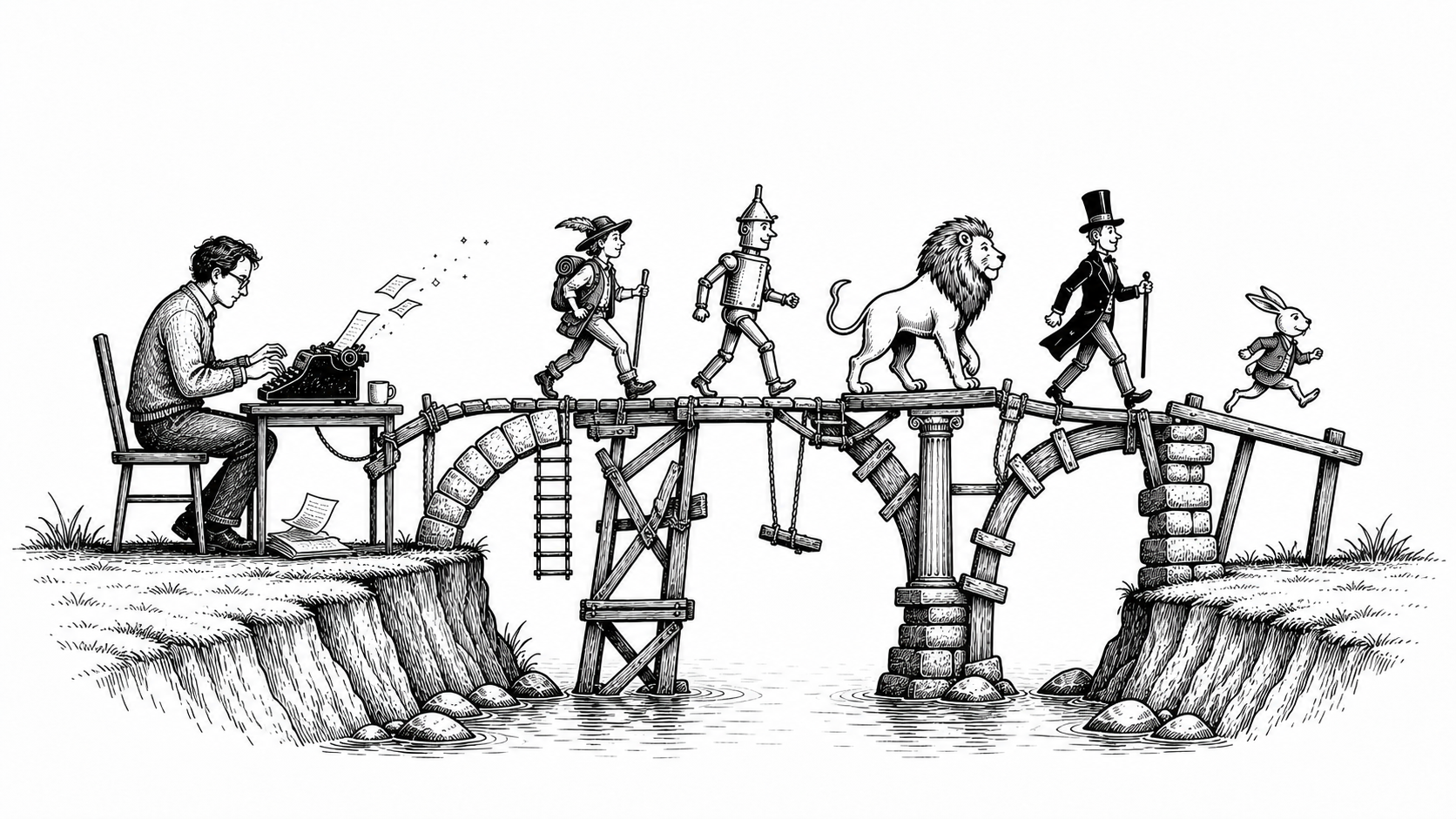
There is an entire industry devoted to preventing writers from writing until they have acquired enough coloured cards, specialist software and conflicting advice to operate a small regional railway.
Beat sheets. Scene maps. Character questionnaires. Chapter summaries. Three-act structures. Five-act structures. Structures with so many acts that the characters ought to be demanding an interval.
All of them can be useful. None of them is compulsory.
The experienced author-publisher I work with has been writing novels for more than thirty years. He has completed books and series, gathered a substantial readership and survived several generations of publishing technology.
The author-publisher is happy for me to share his experiences if they help other writers. He does not, however, want to be identified.
He has never outlined a novel.
He tried once. He hated it.
If I already knew what the characters were going to do, it would feel contrived.
So, do you need to outline a novel?
No. You need a method that gets one written.
The method that removes the fun
Some writers need to know the destination before setting off. They want the route, the scheduled stops and reasonable assurance that the bridge exists.
For others, knowing everything in advance removes the reason to make the journey.
This is usually called discovery writing or, rather less elegantly, pantsing. The publishing world enjoys inventing undignified names for perfectly respectable activities.
The uncertainty is not a flaw in his process. It is the part that keeps him at the desk. Instead of transcribing decisions already made, he is finding out what happens.
Sometimes he knows the ending. Sometimes he knows a moment buried somewhere in the middle. Often he begins with little more than an idea for one part of a book and the suspicion that something interesting might be hiding around it.
Sometimes the story begins with chapter ten
A book does not always arrive in numerical order.
I write in chunks, like pieces of a jigsaw, and then put them together.
Those pieces are not stored in separate folders, pinned to a wall or entered into software capable of launching a modest satellite. They remain in the manuscript, where chapters traditionally live.
His better metaphor is a bridge.
The beginning stands on one side and the ending on the other. Between them are the sections needed to carry the reader across, but they do not have to be built in order.
Perhaps section two is clear today while section one refuses to cooperate. Section two gets written. If chapter ten has arrived fully formed, chapter ten goes into the manuscript now. The missing sections become challenges: how do the characters reach the piece that already exists?
To a committed planner, this may sound like discovering halfway across a ravine that the bridge was being assembled by committee. To a discovery writer, it creates momentum. Each completed section gives the story somewhere else to go.
Why it does not become an incoherent bloody mess
The obvious objection is that a manuscript written in pieces must eventually resemble a box of assorted plumbing parts accompanied by instructions for a wardrobe.
Apparently not.
In more than thirty years of writing this way, he says he has never reached the end and decided the entire story was an incoherent bloody mess. There may be a gap to fill or a transition to strengthen. One part of the bridge may be waiting for its bolts. The structure itself usually remains recognisable.
He attributes that to character.
His novels are driven by people, psychology and the consequences of human behaviour. He does not begin by deciding what every character must say in order to drag the plot obediently towards a predetermined destination.
The characters define what they say—and that decides how the story develops.
The writer still created them. Nobody is claiming supernatural dictation, although novelists have been known to become evasive when asked where dialogue comes from.
What develops is a sufficiently strong understanding of a character that some responses feel inevitable and others feel false. A decision creates a consequence. The consequence creates the next problem. The plot moves because the people inside it have done something inconvenient.
Painting himself into an ending
One of his most popular novels began by revealing a scene that belonged much later in the story.
The opening presents a transcript of an emergency telephone call. A distressed caller asks for help and delivers the essential information: everybody is dead.
That was written before he knew how the story would arrive there.
I painted myself into an ending. Then the question became: how the hell does it end up that way?
He knew the emotional atmosphere he wanted and the scale the conclusion should achieve. He did not yet possess the route connecting the first warning to the final catastrophe.
That was the attraction.
The opening made a promise. The characters, with their tensions, loyalties and capacity for making matters worse, discovered how it would be fulfilled.
An outliner might regard this as an avoidable emergency. A discovery writer calls it Tuesday.
Writing out of order does not remove structure
Writing without an outline is not the same as publishing without structure. Readers remain oddly attached to books that make sense.
A novel still requires movement and shape. It still needs a beginning, a middle and an end, even when those parts were not written in that order. The difference is when the structural work happens.
For a planner, much of it happens before drafting. For a discovery writer, it happens through drafting and revision.
The first completed version in this process is the skeleton draft. Ideally, it contains a readable story from beginning to end, although an occasional gap may remain.
The next version puts meat on the bones. Scenes deepen, missing connections are made and the human detail becomes richer. He regards this as the first proper draft and sends it to a focus group.
Their reactions inform another pass concentrating on what needs changing, followed by work on syntax, precision and polish. Depending on the book’s complexity, the manuscript generally passes through three or four substantial versions before or during typesetting.
This is not a process without planning. The plan has simply been discovered inside the manuscript rather than prepared in advance and presented with coloured tabs.
The only rule worth keeping
There is no morally superior writing method.
An outline can expose structural problems early and give a writer the confidence to begin. It can also become a beautifully organised method of postponing the first sentence.
Writing advice is usually one person describing the system that works for that person. The difficulty begins when a preference dresses itself as a law.
A first draft does not have to prove that you understood the entire book before writing it. It needs to produce a book that can then be understood.
Gaps can be bridged. Sections can be moved. Characters can be deepened. Sentences can be rescued from things they did not deserve.
None of that can happen to a novel that exists only as an immaculate collection of planning documents.
After thirty years, his advice is shorter than most writing manuals:
Everything else can be fixed once it exists.


Leave a Reply