
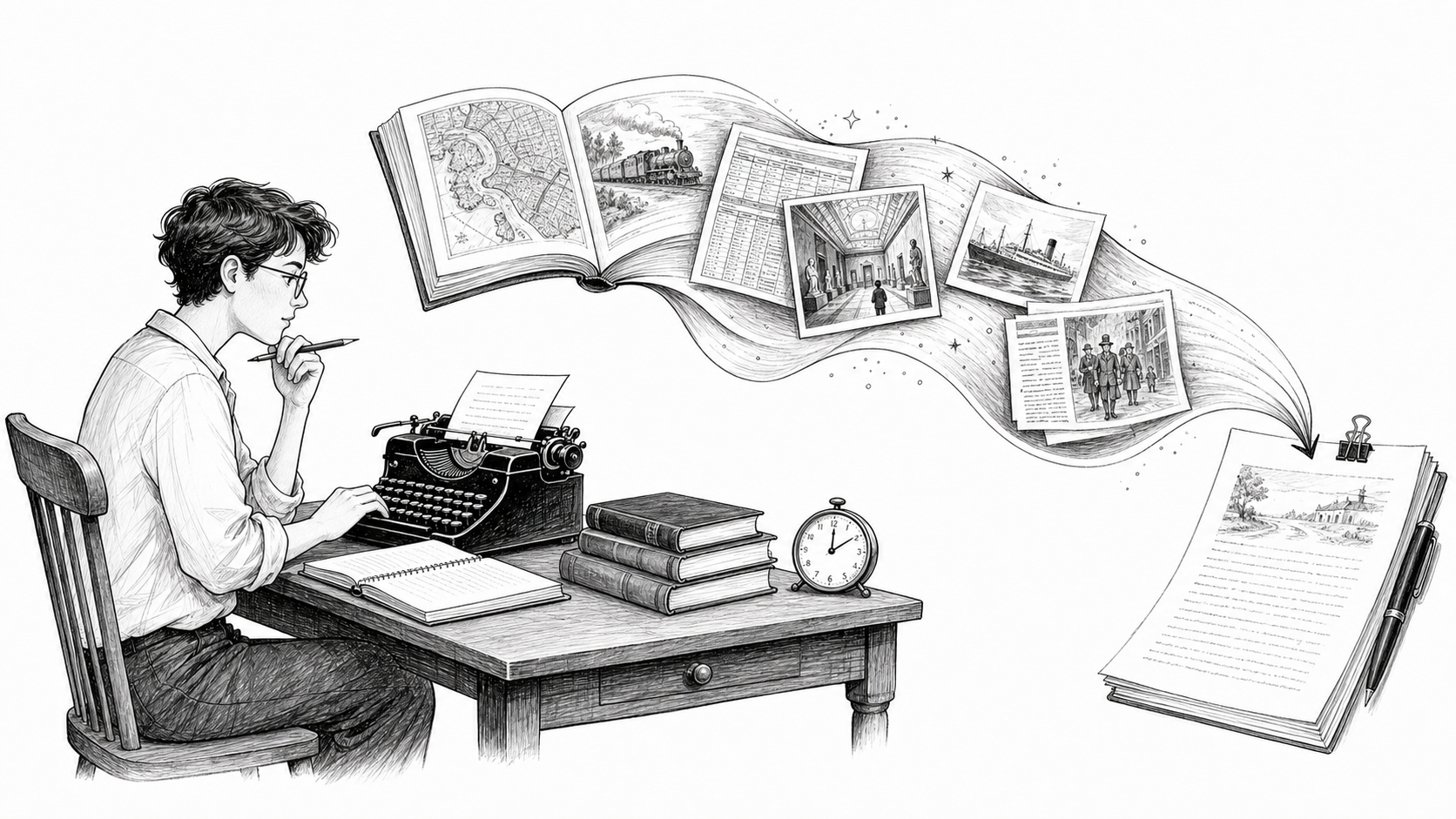
Research is one of fiction’s great pleasures. It lets you spend an afternoon discovering how a 1920s railway station smelled, what a deep-sea welder actually does, or whether your detective can plausibly buy a sandwich at 3 a.m. in a particular town.
It is also a spectacularly respectable way to avoid Chapter Seven.
The trick is not to research less. It is to give research a job description. You are not applying to become the world’s leading authority on eighteenth-century canal tolls. You are trying to write the next truthful, vivid scene.
Start with questions, not a browsing tab
Before you search, make a short list of what the story genuinely needs. Split it into three columns:
- Must be right: facts a reader could reasonably challenge—dates, laws, geography, procedures, ranks and technology.
- Must feel right: texture—sounds, routines, social habits, objects and vocabulary.
- Nice to know: the fascinating rabbit hole about Victorian shoe fastenings. Save it for later; it will still be there, wearing tiny boots.
Put a scene beside each question. “How did a 1940s boarding house take bookings?” is useful because it changes what your character can do. “Tell me everything about British telephones from 1938 to 1952” is how an innocent Tuesday disappears wearing a trench coat.
Research earns its chair at the desk when it gives the character a choice, obstacle, detail or consequence.
Build a source ladder
Search results are leads, not evidence. Climb towards the source closest to the thing you need.
- Primary material: letters, photographs, maps, newspapers, manuals, court records, official documents, oral histories and contemporary catalogues.
- Reliable explainers: museum, archive, university and specialist-library guides that put the material in context.
- Good secondary work: books and articles by named experts with clear citations.
- Everything else: useful for vocabulary and avenues to explore, but never the only peg holding up a factual claim.
The Library of Congress describes primary sources as the raw materials of history. That does not make every diary a complete truth-serum test; it does mean a period advert or photograph can give you deliciously specific detail that a dozen generic webpages cannot.
For a historical setting, search the place, year and institution together: “Liverpool 1891 hospital rules”, “Duluth 1936 classified ads”, “Birmingham 1974 bus timetable”. Catalogue filters are your friends. The US National Archives’ catalog guide explains how date, location and material-type filters narrow a search—and reminds us that OCR text, especially from handwriting, needs human checking.
Verify the load-bearing facts
Not every line needs three footnotes. The facts that change the plot do.
If a detail controls a character’s freedom, money, safety, job or relationship, check it independently. A police procedure, immigration rule, medical treatment or train timetable can quietly wreck a scene if you get it wrong. Look for a second source that does not merely repeat the first one. Cornell Library’s advice is usefully blunt: assess reliability and independently verify information rather than trusting a search result or social feed.
Keep a tiny research ledger as you go: the fact, the source link, the date you checked it and the scene it serves. Future You will regard this as an astonishing act of kindness. Present You will be too busy writing to notice.
Collect texture, then stop
Facts prevent howlers. Texture makes a setting breathe. A one-line weather report, a price list, an old menu, a local phrase or the layout of a room can do more on the page than a paragraph of exposition.
But use a detail because it belongs to the character’s attention, not because you suffered for it. If your protagonist is waiting outside a factory, the valuable research may be the shift whistle, the oily smell, the lunch pails and the queue at the gate—not the entire corporate history of ironworking. The reader needs the scene, not your browser history.
This is the same discipline we use when deciding what makes dialogue sound like people: choose the telling thing, then let the reader do some work.
Give research a fence
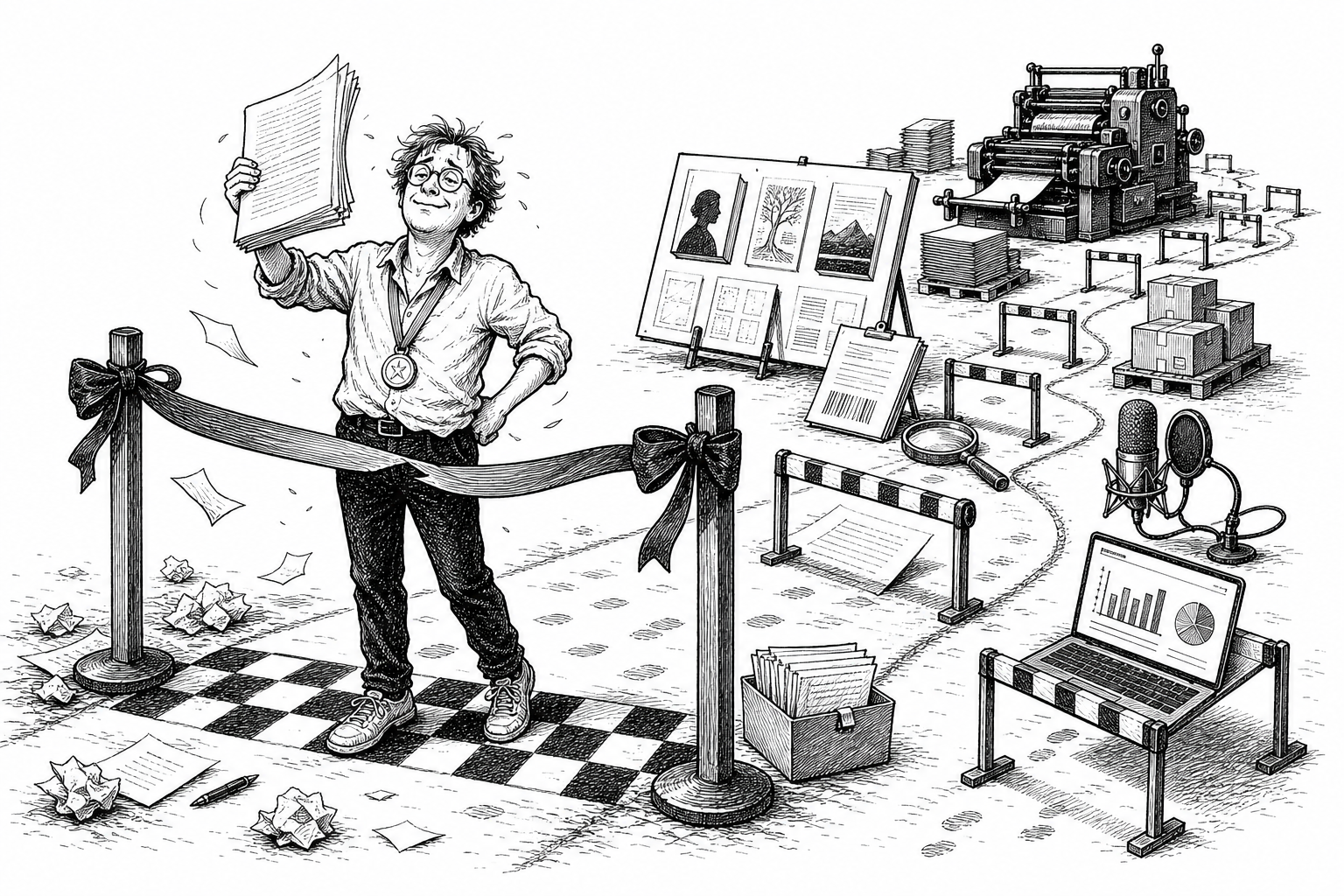
Set a research sprint before you begin: forty-five minutes, a fixed question and an output. The output might be five bullet-point facts, a folder of three images, a paragraph of sensory notes or a single corrected line in the draft.
When the timer ends, write the scene with the best information you have. Mark uncertainties with a bright placeholder—[CHECK: could she legally do this?]—and keep moving. Later, run one focused fact-check pass. That is far more useful than reopening the whole internet every time you need a teacup.
If research is making you feel industrious while the manuscript remains untouched, it has become procrastination in a sensible hat.
If the research starts changing the book, great. Update the question and your outline. If it merely provides a fresh excuse to read fourteen pages about municipal drains, close the tab and write the damp alleyway.
Use quotes, images and other people’s work carefully
Research is not a buffet where copyright goes on holiday. Quote only what you need, keep clear records of where it came from, and check the rights and licence for every image or substantial extract. In the United States, the Copyright Office explains that fair use is case-specific; there is no magic “safe” word count. If your book will rely on someone else’s text, photograph, archive item or interview, get appropriate permission or specialist advice.
Turn the notes back into a novel
At the end of a session, ask four questions:
- What does my character now know, misunderstand or want?
- What concrete detail can appear naturally in the next scene?
- Which fact still needs checking?
- What is the next sentence of the manuscript?
Then write that sentence. Research should make the novel stranger, truer and more alive—not become the novel’s very elaborate substitute.
And when you have a first draft worth showing, our guide to when to show your novel to other people can help with the next brave bit.
Sources and further reading
- Library of Congress: Primary Sources
- US National Archives: Using the National Archives Catalog
- Cornell University Library: Getting Started with Library Research
- US Copyright Office: More Information on Fair Use







Leave a Reply