
A character stops sounding like a person the moment you can hear the author standing behind them with a clipboard. The line may be grammatical. It may deliver the required information. It may even contain an expensive word. But nobody in the room would actually say it.
Natural dialogue is not simply dialogue that resembles speech. It has to sound like this particular person, in this particular mood, talking to this particular person while trying to get something, hide something or avoid having the conversation altogether.
This is one part of the larger journey from first idea to finished publication. If you are still working out what comes before and after the dialogue, start with our complete guide to writing and publishing a book.
That is why the cure is rarely a packet of quirky phrases. Your characters do not become individuals because one says “indeed”, another swears and a third has been sentenced to mention cricket every four pages. They sound different when they are different.
The real test is not “Does this sound natural?”
The better question is: does this sound like this person?
If you know a character well enough, the wrong line should jar. Their background, profession, temperament, history, class, confidence and private contradictions all shape what they say—and what they refuse to say.
For the author-publisher whose experience informs this article, much of that voice emerges during the writing. Decide that somebody is an architect or a doctor, give them a name and a face, and their life begins to backfill itself. Where did they grow up? What did it cost them to get here? What do they resent? What would embarrass them if anybody found out?
Writing the story becomes a kind of acting workshop conducted in real time. The character develops on the page, and the voice develops with them. That is one reason an outline must remain a servant rather than a small uniformed dictator. If the character is forced to say whatever the plot document requires, the reader can hear the paperwork rustling.
Natural dialogue is not about whether somebody might say the line. It is about whether this person would.
The dirtier the better—within reason
Real conversation is untidy. People interrupt. They hesitate, double back, answer a different question, start a sentence and abandon it halfway through. Angry people talk over one another. Nervous people babble. Awkward people discover an urgent professional interest in the carpet.
Dialogue that is too clean can sound like two solicitors reading alternating clauses from the same contract. Everybody waits politely. Every sentence arrives fully dressed. Nobody misunderstands anything. It is efficient, clear and quite dead.
The answer is not to transcribe real speech in all its repetitive glory. A genuine argument can circle the same grievance for twenty minutes; on the page, that feels less like realism and more like being trapped at somebody else’s dinner table. Let the characters generate the mess, then edit the scene so the mess has momentum.
Keep the interruptions that expose power. Keep the hesitation that reveals fear. Keep the repeated phrase that shows an obsession. Remove the fourth lap around exactly the same point. Realistic dialogue should feel lived-in without making the reader live there indefinitely.
People rarely say what they mean
Human beings avoid vulnerability, arguments and uncomfortable truths with extraordinary commitment. They soften, dodge, deflect, lie and occasionally ask whether anyone wants tea at the precise moment a marriage is collapsing.
That is subtext. It is not an advanced literary garnish sprinkled over a finished scene. It is ordinary human behaviour. A character may say “Fine” because saying what they actually feel would start the argument they are trying to postpone. Another may change the subject because the reader is not yet meant to know what happened—and because the character has spent fifteen years making sure nobody does.
Withholding information serves the story twice: it feels human and it creates tension. The reader becomes a willing voyeur, watching the gap between what is said and what is true.
Silence is not an empty space in dialogue. Sometimes it is the loudest line in the scene.
Stop turning characters towards the camera
Bad exposition has the unmistakable air of an advert in which an actor holds up the product and explains the problem in a voice no human being has ever used voluntarily.
“As you know, John, since our parents died in that mysterious boating accident ten years ago…” is not dialogue. It is the author wheeling a filing cabinet into the scene.
Information can arrive through objects, behaviour, omission and internal thought. A photograph on a mantelpiece can establish a relationship. A uniform in an old picture can disclose a history. A character forgetting an anniversary can reveal rather more than three paragraphs about the state of a marriage.
If you are still building the story’s framework, our article on whether you need to outline a novel deals with the balance between structure and discovery. The outline needs to help the characters reach the story—not force them to deliver it like a quarterly report.
Trust the scene before adding instructions
If the scene has been set properly, “he said angrily” is often redundant. The distance between the characters, folded arms, clipped answers and atmosphere should already be doing the work. By the time the line arrives, the reader ought to know it has not been delivered with the carefree delight of somebody receiving a complimentary pudding.
Over-explaining every emotion is not clarity. It can be lazy writing: the author labels the effect instead of creating it. Double exclamation marks do not make the situation twice as urgent, either. They merely suggest that one exclamation mark has called for assistance.
This is learned through good teaching, careful reading and experience. It is also learned by trusting readers to recognise anger when two people have spent the entire scene trying not to throw a lamp.
Different voices come from different people
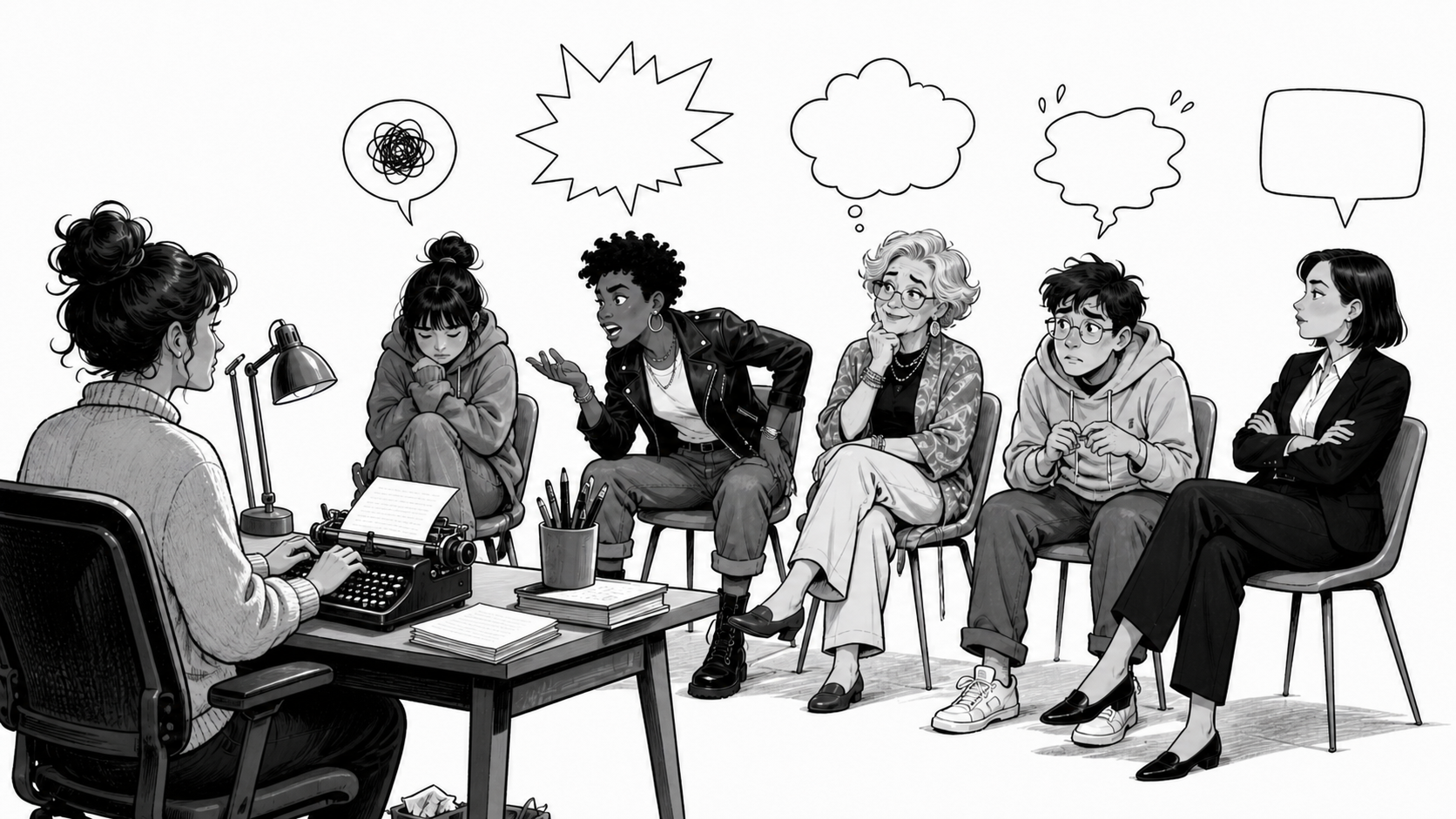
Put five people in a room and even those with similar backgrounds will begin to grate against one another in revealing ways. One is shy. One fills every silence. One needs to win. One watches. One uses humour as armour. Their voices are consequences of who they are, not accessories fitted afterwards.
Avoid replacing people with types. The street lad, the rich snob and the flawless hero are not characters until they acquire contradictions. Perfection is particularly deadly. A hero who is handsome, altruistic, endlessly competent and kind to small animals is not reassuring. He is suspicious. Readers know human beings better than that.
If several characters have merged into one voice, go backwards before you fiddle with their vocabulary. What does each person want from the scene? What are they hiding? Who has the power? What will they never admit? If the answer is identical for all of them, the problem is not punctuation.
Humour belongs to the character
Humour is where writers can most clearly be heard trying. A carefully installed witticism sits in the dialogue wearing a paper hat and waiting for applause. Genuine humour grows from character, culture and circumstance.
A dry, restrained character will not suddenly become a slapstick delivery system because the chapter has been serious for six pages. A joke that belongs to the writer may interrupt the person speaking it. A funny line that belongs to the character deepens them.
The useful test is simple: if you are waiting for the laugh because you know where you put the joke, it may be contrived. If the character makes you laugh when you meet the line again, it probably belongs to them.
Go and watch some humans
When characters stop sounding like people, spend more time with people. Sit in a café. Watch documentaries. Notice how confidence changes the way somebody orders coffee, how awkwardness occupies the hands, how a person answers the phone differently depending on who is calling.
Actors research roles by watching the people they are going to portray. Writers should be at least as curious. Films can teach structure and performance, but documentaries and ordinary life provide the untidier evidence: the pauses, evasions, habits and tiny acts of self-protection that manufactured dialogue tends to sand away.
Then return to the manuscript and ask whether each character sounds like a person with a history, an objective and something at stake—or like the same author moving from chair to chair.
If the problem runs deeper than dialogue, start with how to know when a novel isn’t working. If the characters are ready but you need outside ears, see when to show your novel to other people.
Characters do not need to speak perfectly. They need to speak truthfully—which is much messier, much harder and considerably more interesting.











Leave a Reply